We do the sorting. You do the medicine.
Intra-operative crises · Core15 / 21

Delayed LAST after bilateral TAP catheters81-year-old woman, 46 kg, frail with low muscle mass; mild chronic kidney disease

Local anaesthetic toxicity: delayed onset, lipid emulsion and modified arrest drugs

From memory: the diagnosis and the notes are hidden. Answer each question aloud, then press Show.

Know this first

  • LAST risk factors: extremes of age, low muscle mass, heart disease, high dose and prolonged infusion.
  • Ropivacaine limit is 3 mg/kg; bilateral blocks count as one total.
  • 20% lipid for patients of 70 kg or less: 1.5 mL/kg over 2–3 min, infusion 0.25 mL/kg/min, ceiling 12 mL/kg.
  • In LAST, adrenaline doses start under 1 mcg/kg; vasopressin, beta-blockers, local anaesthetics and calcium channel blockers are avoided.
  • Observe 2 hours after a seizure and 4–6 hours after cardiovascular instability.

The patient

81-year-old woman, 46 kg, frail with low muscle mass; mild chronic kidney disease. Drugs: amlodipine. Elective open right hemicolectomy under general anaesthesia, with bilateral transversus abdominis plane catheters: 20 mL of 0.25% ropivacaine each side, then infusions. Vitals before surgery: BP 138/72, HR 74, SpO2 97% on air, RR 14.

The examiner asks

Answer aloud, then press Show.

  1. Consider

    What concerns you about her analgesia plan?

    Show the answerHide the answer
    • An 81-year-old frail woman, 46 kg, for open hemicolectomy with bilateral plane catheters. Patient
    • Her age and low muscle mass are both LAST risk factors.
    • Both sides count toward one total; ropivacaine's limit is 3 mg/kg. Disease
    • Plane blocks need large volumes, so her dose runs close to that ceiling. Surgery
    • Running infusions on top add risk: prolonged infusion is itself a risk factor. Disease
  2. Plan

    How will you make this safer?

    Show the answerHide the answer
    • Both boluses together kept under 3 mg/kg for her actual weight. Disease
    • Ultrasound to watch the spread, aspirating and injecting 3–5 mL at a time.
    • Lower infusion rates, or alternating-side programmed boluses, instead of two full infusions.
    • Ward staff watch for tinnitus, metallic taste, perioral tingling and confusion, and stop the pumps. After surgery
    • 20% lipid emulsion available wherever she is nursed. Crisis
  3. Crisis

    Three hours after the boluses, in recovery, she is confused and agitated and complains of a metallic taste. BP 150/84, HR 92, SpO2 95%. What do you do?

    Show the answerHide the answer
    • LAST algorithm: confusion and metallic taste after large plane-block doses, not just delirium. Crisis
    • Both infusions off, help called, LAST rescue kit and lipid brought to her.
    • Airway and 100% oxygen; hypoxia, hypercarbia and acidosis all worsen toxicity.
    • No seizure yet; if she fits, midazolam 1–5 mg, or propofol in 20 mg steps.
    • Lipid now: she's under 70 kg, so 1.5 mL/kg over 2–3 minutes, then 0.25 mL/kg/min.
    • Monitored bed: 2 hours' watch after a seizure, 4–6 hours if her circulation was unstable. After surgery
  4. Crisis

    Her QRS widens, HR falls to 38, then she becomes pulseless with a slow broad complex. What now?

    Show the answerHide the answer
    • LAST with arrest: CPR now, and LAST rules change the standard ALS drugs. Crisis
    • Adrenaline in small doses, starting below 1 mcg/kg, not 1 mg.
    • No vasopressin, no beta-blockers, no lidocaine and no calcium channel blockers.
    • Still unstable: give the lipid bolus again and run the infusion at twice the rate, up to 12 mL/kg total.
    • Call the bypass or ECMO team early, while CPR continues.
    • After ROSC: lipid continues 15 minutes past stability, then ICU and an incident report. After surgery

Scan · Transversus abdominis plane

Here is your image. Point to and name each structure, then say why it matters.

Linear 10–15 MHz probe transverse, started midline then moved to between the costal margin and iliac crest (anterior to mid-axillary line).

Transverse lateral abdominal wall, flank; side not marked
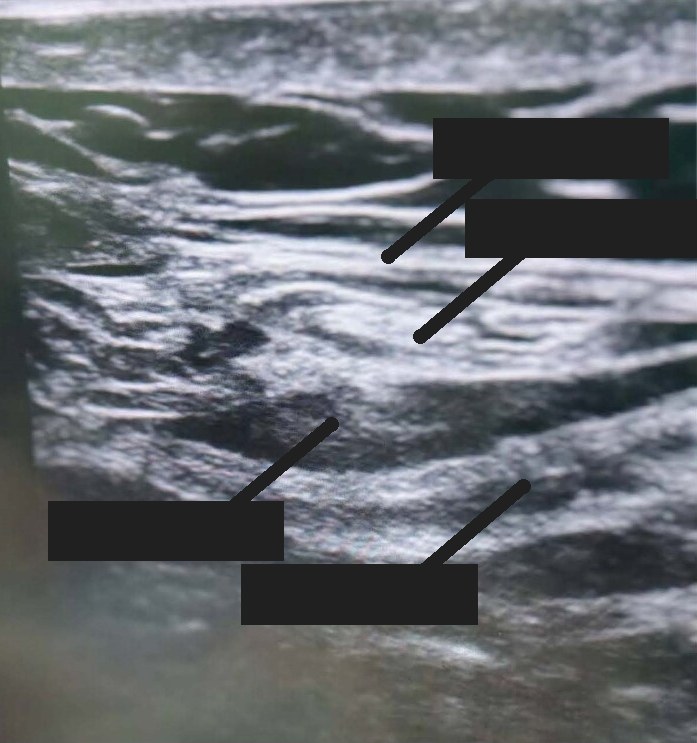
Transversus abdominis plane, labels covered, open the image full size
Show the answerHide the answer
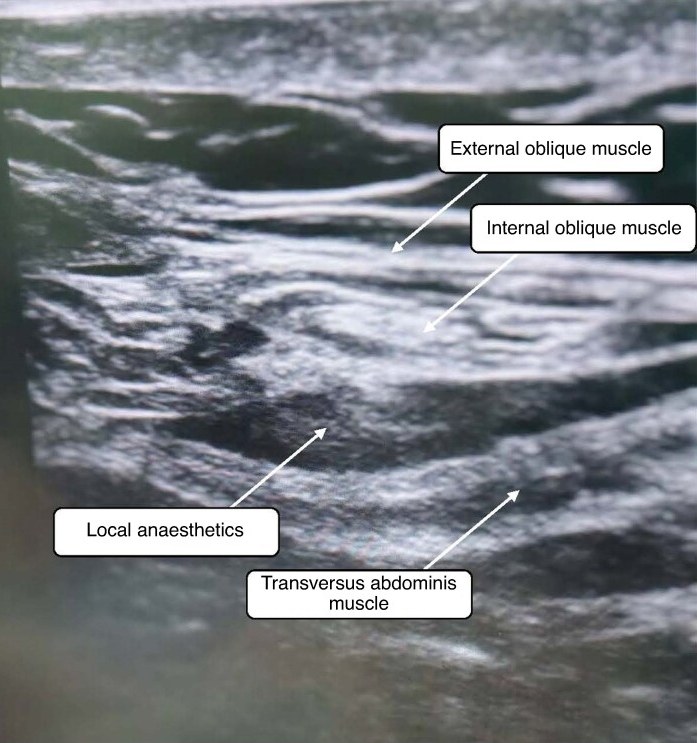
Transversus abdominis plane, labelled, open the image full size

Labels EO external oblique · IO internal oblique · TA transversus abdominis · LA local anaesthetic

  • I start in the middle on rectus, then slide out to the flank.
  • From the top down: external oblique, then internal oblique, then transversus abdominis.
  • My target is the plane under internal oblique and over transversus.
  • This bright line is peritoneum, with moving bowel under it.
  • The block numbs the abdominal wall only, not the gut.
  1. Rectus abdominis Start point in the midline before sliding laterally
  2. External oblique Top layer of the three
  3. Internal oblique Middle layer; injection goes under it
  4. Transversus abdominis Deepest layer; the nerves run above it
  5. Plane between internal oblique and transversus Target: nerves too small to see, so it is a plane block
  6. Peritoneum and bowel Bright line below transversus; avoid puncture, watch peristalsis

Checked against: Barash 9e · Miller 10e

Image: Xu H et al., Comparison of postoperative analgesic effects of ultrasound-guided intercostal nerve block and transversus abdominis plane block in patients undergoing laparoscopic cholecystectomy: randomized clinical trial (BJS Open 2025; doi:10.1093/bjsopen/zraf022), Fig. 1, CC BY 4.0. Changes: Trimmed the left screen edge and machine icon; in the question image the four boxed labels and their arrows are covered with dark grey.

Report a problem with this scan station

Fatal mistakes

  • Calling her confusion postoperative delirium and leaving the infusions running.
  • Standard 1 mg adrenaline doses in a LAST arrest.
  • No lipid emulsion.
  • Vasopressin or a calcium channel blocker during LAST.

Checked against: Barash 9e · ASRA Pain Medicine Local Anesthetic Systemic Toxicity checklist: 2020 version · AHA guidelines: special circumstances of resuscitation (2025)

Report a problem with this case

Mark Got it only if you said every point. Again brings the case back tomorrow; Got it brings it back in 3, then 7, 14 and 30 days.

Same topic, another patient

Run these after the main case when you have time. Same skills, a different patient or setting.

Another patient · Obstetric anaesthesia. LAST during epidural top-up for caesarean. Same toxicity crisis in labour: uterine displacement, resuscitative delivery decision

Know this first

  • Test dose: adrenaline 15 mcg; positive if HR rises 10 or more and SBP 15 mmHg or more.
  • Extension: 2% lidocaine with adrenaline or 3% chloroprocaine, 15–25 mL in divided doses.
  • Lipid 20%, 70 kg or less: about 1.5 mL/kg over 2–3 min, then 0.25 mL/kg/min.
  • In LAST: adrenaline below 1 mcg/kg; local anaesthetics, calcium blockers, beta-blockers and vasopressin are avoided.
  • No ROSC at 4 minutes: resuscitative delivery, complete by 5.

The patient

30-year-old woman, 64 kg, at 39 weeks, in labour with an epidural resited 1 hour ago; otherwise well. Failure to progress; urgent caesarean (category 2) planned using an epidural top-up. Drugs: oxytocin infusion. Vitals: BP 116/70, HR 90, SpO2 99% on air, RR 16.

The examiner asks

Answer aloud, then press Show.

  1. Consider

    What are your considerations?

    Show the answerHide the answer
    • A 30-year-old at 39 weeks for urgent caesarean, extending an epidural resited an hour ago. Patient
    • At term: aortocaval compression, aspiration risk, difficult airway, and her fetus to protect.
    • A new catheter is untested at surgical doses; it may still sit in a vein or the CSF. Disease
    • Category 2 gives time to extend safely and confirm a T4 block. Surgery
  2. Plan

    How do you extend her epidural?

    Show the answerHide the answer
    • Aspirate the catheter, then 3 mL of 1.5% lidocaine with adrenaline 15 mcg. Disease
    • Positive if her heart rate rises 10 or more and systolic 15 mmHg or more.
    • Then 2% lidocaine with adrenaline 1:200,000, 15–25 mL in divided doses over 5–10 minutes.
    • Or 3% chloroprocaine, rapidly cleared; 0.5% bupivacaine avoided for its toxicity risk.
    • Between doses I ask about tinnitus, dizziness and numb lips.
    • Lipid emulsion and the LAST checklist in the room before I start. After surgery
  3. Crisis

    After 10 mL her lips tingle and her ears ring, then she has a generalised seizure. SpO2 90%, BP 150/90, HR 120. What do you do?

    Show the answerHide the answer
    • LAST algorithm: injection stopped, help called, LAST kit fetched, bypass team warned. (Crisis)
    • Airway first: 100% oxygen and support her breathing; intubate early, she's a full stomach.
    • Seizure: midazolam 1–5 mg IV; propofol only in 20 mg steps if nothing else.
    • Lipid 20% early: under 70 kg, about 1.5 mL/kg over 2–3 minutes, then 0.25 mL/kg/min.
    • Left uterine displacement throughout; fetal heart checked once she is stable.
  4. Crisis

    Two minutes later: broad-complex tachycardia, then VF; no pulse. What do you do?

    Show the answerHide the answer
    • LAST arrest at term: CPR with manual uterine displacement; shock VF at standard energy. Crisis
    • Adrenaline in small doses, under 1 mcg/kg; lidocaine, calcium blockers, beta-blockers and vasopressin are all out.
    • Still unstable: repeat the lipid bolus and double the infusion, up to 12 mL/kg in total.
    • Amiodarone 300 mg for refractory VF, never lidocaine.
    • Delivery kit open from the start; no ROSC by 4 minutes, baby out by 5.
    • Prolonged CPR is justified; bypass or ECMO if lipid and CPR fail.
    • Once stable, observe at least 4–6 hours; report the event and restock lipid. After surgery

Fatal mistakes

  • Standard 1 mg adrenaline boluses in LAST.
  • No lipid emulsion given.
  • Lidocaine for the ventricular arrhythmia.
  • Bolus top-up without aspiration or fractionation.

Checked against: ASRA Pain Medicine Local Anesthetic Systemic Toxicity checklist: 2020 version · Barash 9e · Miller 10e

Report a problem with this patient

Another patient · Paediatric anaesthesia. Local anaesthetic toxicity from a ward nerve catheter. Same toxicity crisis in a child: weight-based infusion limits

Know this first

  • Bupivacaine infusions: up to 0.4 mg/kg/h over 1 year, 0.2 mg/kg/h in infants.
  • In children, cardiac toxicity can appear before obvious neurotoxicity.
  • Lipid 20%: 1.5 mL/kg over 2–3 min, then 0.25 mL/kg/min, to a ceiling of 12 mL/kg.
  • LAST resuscitation differs: smaller adrenaline, starting below 1 mcg/kg; vasopressin, beta-blockade, calcium-channel blockade and more local anaesthetic avoided.
  • Observe 2 hours after a seizure, 4–6 hours after cardiovascular instability.

The patient

7-year-old boy, 20 kg, day 1 after femoral shaft plating, with a continuous femoral nerve catheter on the ward. Bupivacaine 0.25% infusing at 4 mL/h; nurses gave two 5 mL boluses overnight for pain. No regular drugs. Vitals: HR 104, BP 102/60, SpO2 98% on air, RR 22.

The examiner asks

Answer aloud, then press Show.

  1. Consider

    You review his catheter on the ward rounds. What matters?

    Show the answerHide the answer
    • A 7-year-old with a femoral bupivacaine infusion plus nurse boluses, on a general ward. Patient
    • In a child toxicity may show as arrhythmia first, before seizures are noticed.
    • Ceiling for infusions over 1 year: 0.4 mg/kg/h; boluses count towards it. Disease
    • Local anaesthetic toxicity is a recognised cause of arrest in children.
  2. Plan

    How should this infusion be run?

    Show the answerHide the answer
    • Audit his total hourly dose, infusion plus boluses, against the 0.4 mg/kg/h ceiling. Disease
    • Dedicated pump; concentration and rate checked by two nurses.
    • Pain team review; paracetamol 15 mg/kg rather than repeated boluses. After surgery
    • Lipid emulsion and the LAST checklist on the ward. Crisis
  3. Crisis

    An hour later he is agitated, tastes metal, then has a generalised seizure; SpO2 88%. What now?

    Show the answerHide the answer
    • LAST algorithm: seizure on bupivacaine; stop the infusion and get help. (Crisis)
    • LAST kit brought; airway, 100% oxygen, and ventilate him.
    • Seizure: benzodiazepine first, lorazepam 0.1 mg/kg IV.
    • Propofol only in small doses if no benzodiazepine is available.
    • Lipid 20% early: 1.5 mL/kg over 2–3 minutes, then 0.25 mL/kg/min.
    • Move him to a monitored area; ECMO team alerted.
  4. Crisis

    He then has a broad-complex tachycardia, BP 60/30, and loses his pulse. What now?

    Show the answerHide the answer
    • LAST arrest: PALS CPR, but drugs follow the LAST rules. Crisis
    • Shockable rhythm: first shock 2 J/kg, later shocks 4 J/kg.
    • Adrenaline smaller than usual: under 1 mcg/kg, after the second shock.
    • Lipid bolus repeated, infusion rate doubled, up to 12 mL/kg in total.
    • Avoided in him: vasopressin, beta-blockade, calcium-channel blockade, extra local anaesthetic.
    • Not responding: ECPR.
    • Once stable, lipid continues 15 minutes; observe 4–6 hours; incident report and pump check. After surgery

Fatal mistakes

  • No lipid emulsion.
  • Standard arrest doses of adrenaline in LAST.
  • Infusion left running after symptoms start.

Checked against: Barash 9e · ASRA Pain Medicine Local Anesthetic Systemic Toxicity checklist: 2020 version · Miller 10e · AHA and AAP guidelines: pediatric advanced life support (2025)

Report a problem with this patient

All Intra-operative crises casesBack to today