DOPS: scalpel front-of-neck access in CICODOPS: a 45-year-old woman, 98 kg, after failed intubation and a failed second-generation supraglottic airway
DOPS: scalpel-bougie-tube front-of-neck access when you cannot intubate or oxygenate
From memory: the diagnosis and the notes are hidden. Answer each question aloud, then press Show.
Know this first
- Kit: size 10 scalpel blade, bougie, 6.0 cuffed tube.
- Full neuromuscular block and maximal neck extension.
- Vertical incision is the default if the membrane is impalpable or uncertain, up to 8 cm.
- Bougie advanced 10–15 cm; confirm with waveform capnography.
- Afterwards: exclude bronchial intubation and pneumothorax; surgical review.
The patient
The examiner asks
Answer aloud, then press Show.
Prepare
What do you declare and set up?
Show the answerHide the answer
- This is CICO. I say it aloud and call for help. (Procedure step)
- Confirm she is fully paralysed; after sugammadex, a relaxant other than rocuronium.
- Kit: a size 10 scalpel, a bougie and a 6.0 cuffed tube.
- Maximal neck extension with a pillow under her shoulders.
- Oxygen continues from above through the supraglottic airway or facemask.
Perform
Talk me through the procedure.
Show the answerHide the answer
- Right-handed, I stand on her left and stabilise the larynx with my left hand. (Procedure step)
- Her neck is thick, so a vertical midline incision up to 8 cm, bottom to top.
- Blunt finger dissection; find the cricothyroid membrane with my index finger.
- Transverse stab through the membrane, blade towards me, then rotate it to point to the feet.
- Slide the bougie along the blade into the trachea, advancing 10–15 cm.
- Railroad the 6.0 tube, cuff up, ventilate with 100% oxygen, confirm with capnography.
Crisis
Blood fills the wound and you can't see or feel the membrane. SpO2 70%.
Show the answerHide the answer
- Keep going: I work by feel, not by sight. (Crisis)
- Extend the incision and dissect bluntly down to the membrane.
- My assistant suctions; the bleeding is dealt with once the airway is secure.
- If still failing: change position, change operator, or use a smaller tube.
Crisis
The tube is in and the cuff is up, but there is no capnography trace. SpO2 65%, HR 40.
Show the answerHide the answer
- No trace means it isn't in the trachea, or there's no circulation. Crisis
- Check the circuit and look for chest movement; if in doubt, take it out.
- Remove the tube, pass the bougie through the membrane again, and railroad again.
- Check a pulse; if there's none, start CPR.
- Once confirmed: secure it, exclude bronchial intubation and pneumothorax, get surgical review. After surgery
Scan · Cricothyroid membrane
Here is your image. Point to and name each structure, then say why it matters.
Midline sagittal over the larynx, neck extended, marked before induction (probe type not given in the corpus).
Transverse at the cricothyroid membrane, anterior at top, midline centred
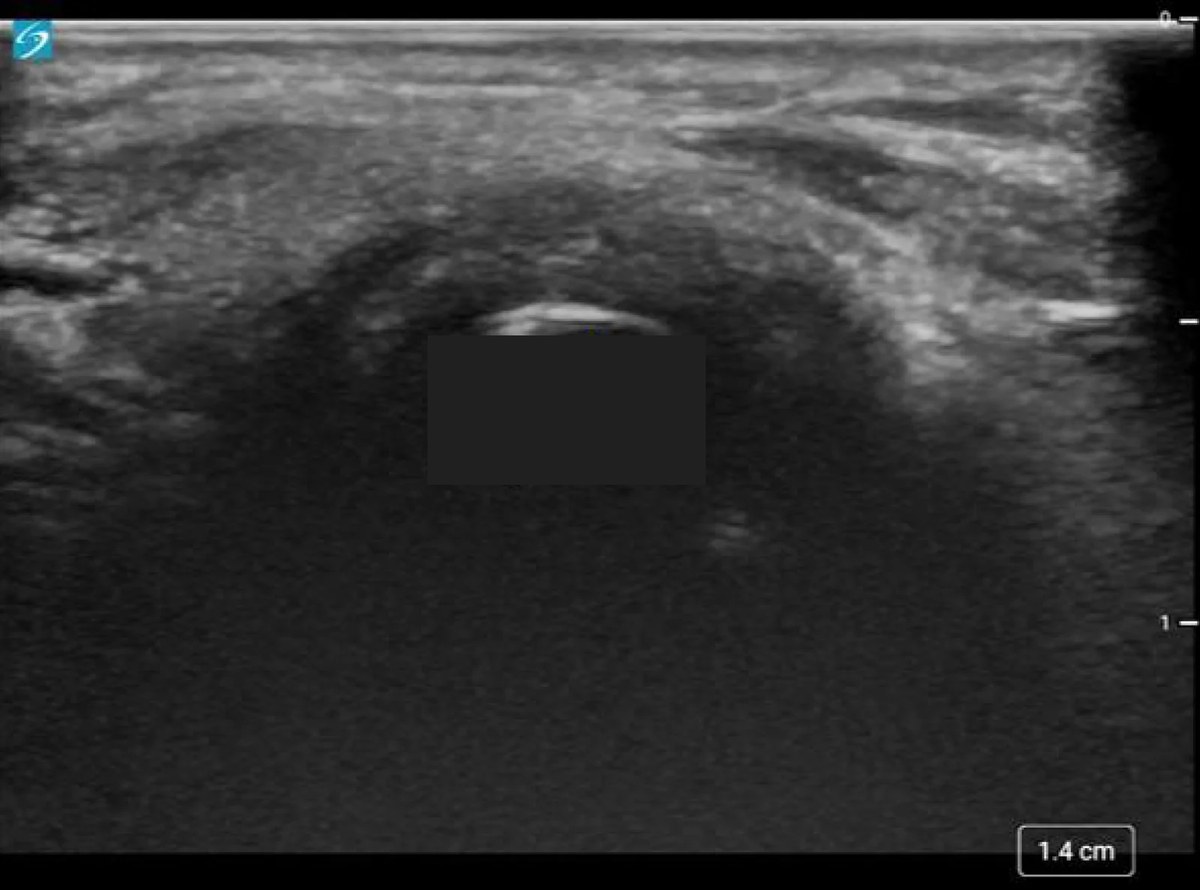 , open the image full size
Show the answerHide the answer
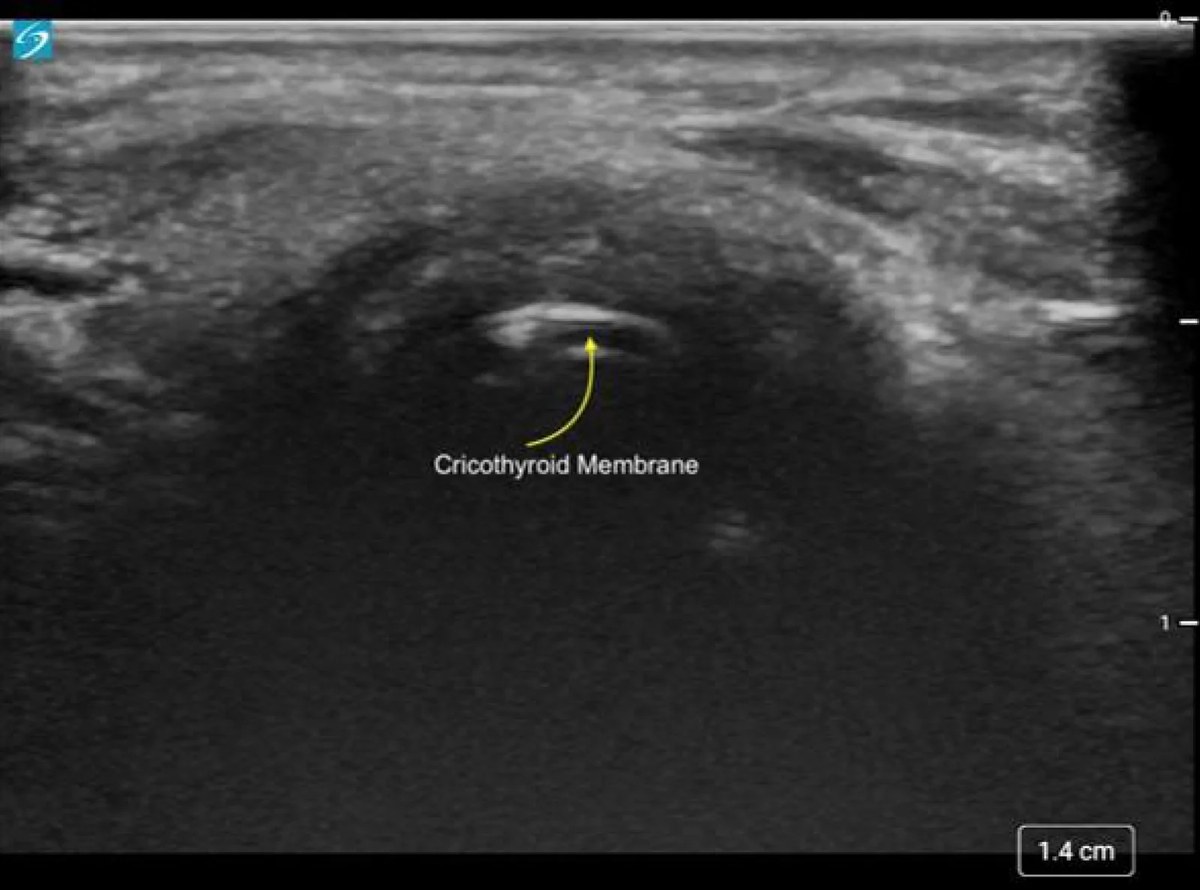 , open the image full size
Labels Arrow: cricothyroid membrane
- With the neck extended, this is thyroid cartilage at the top.
- Below it, this gap is the cricothyroid membrane, my target.
- Next comes cricoid cartilage, then the tracheal rings.
- I mark the membrane before induction, because feeling for it often fails.
- I enter its lower third to keep away from the cords above.
- Thyroid cartilage Upper landmark; membrane sits a finger or so below
- Cricothyroid membrane Target; puncture its lower third, aiming backward
- Cricoid cartilage Ring below; a backward-probing needle hits its rear
- Tracheal rings First ring faces C6; confirms you are below cricoid
Checked against: Barash 9e · DAS 2025
Image: Akhter N et al., Airway Ultrasound: Applications in Pediatric Anesthesiology and Critical Care (J Clin Med Res 2026; doi:10.14740/jocmr6635), Figure 9, CC BY 4.0. Changes: Resized to 1200 px wide. Question image: the yellow arrow and the 'Cricothyroid Membrane' label covered with one box under the membrane line
Fatal mistakes
- Delaying front-of-neck access.
- No capnography confirmation.
Checked against: DAS 2025
Report a problem with this case
Mark Got it only if you said every point. Again brings the case back tomorrow; Got it brings it back in 3, then 7, 14 and 30 days.