Cancelling surgery: weekly GLP-1 agonist and a fried breakfastActor: a 45-year-old woman on weekly semaglutide (last dose 3 days ago) for day-case laparoscopic cholecystectomy
From memory: the diagnosis and the notes are hidden. Answer each question aloud, then press Show.
Know this first
- GLP-1 agonists delay gastric emptying; aspiration risk persists even after standard fasting.
- Light meal: 6 h; fried or fatty food or meat: 8 h or more; clear fluids: 2 h.
- Higher risk: weekly dosing, escalation, higher dose, GI symptoms.
- ASA: hold weekly injections one week before; Kindel: liquid diet for 24 h.
- Gastric ultrasound or RSI are shared decisions weighed against cancelling.
The patient
The examiner asks
Answer aloud, then press Show.
Open
How do you open?
Show the answerHide the answer
- I'm speaking to a woman on weekly semaglutide whose gallbladder operation I've cancelled after breakfast. Patient
- I'm the anaesthetist. I'm sorry you've waited so long. Can I explain why today isn't safe? Communication
- Can you tell me what you ate this morning, and when?
Explain
Explain why you are cancelling.
Show the answerHide the answer
- Asleep, food left in the stomach can come back up and get into the lungs. (Communication)
- A fried breakfast needs eight hours or more to clear; it's been four.
- Your weekly injection also slows the stomach, and your nausea suggests food is still there.
- Even fully fasted, people on these injections can still have food in the stomach.
- I considered scanning your stomach, or a fast way of putting you to sleep; neither makes this worth it.
Respond
She shouts: 'I took a day off work for this!'
Show the answerHide the answer
- You're right to be angry. You've lost a day and waited hours without news. (Communication)
- I'm sorry about the wait. That's our failing, not yours.
- I'd rather cancel than risk a serious lung injury from an operation that can wait.
Respond
She offers: 'I'll sign something. I'll take the risk.'
Show the answerHide the answer
- I appreciate that, but a signature doesn't make an unsafe anaesthetic safe. (Communication)
- If this were an emergency, we'd go ahead with extra precautions. It isn't, so we wait.
- I know that's frustrating. It's your lungs I'm protecting, not a rule for its own sake.
Close
How do you close?
Show the answerHide the answer
- I'll ask for a priority date and give you written instructions. (Communication)
- Hold the weekly injection for a week before, agreed with whoever prescribes it.
- Liquids only for 24 hours before; clear drinks are fine until two hours before.
- If you want to complain about the wait, patient relations will help you.
Scan · Gastric antrum
Here is your image. Point to and name each structure, then say why it matters.
Curvilinear low-frequency probe parasagittal in the epigastrium under the left liver lobe, supine then right lateral decubitus.
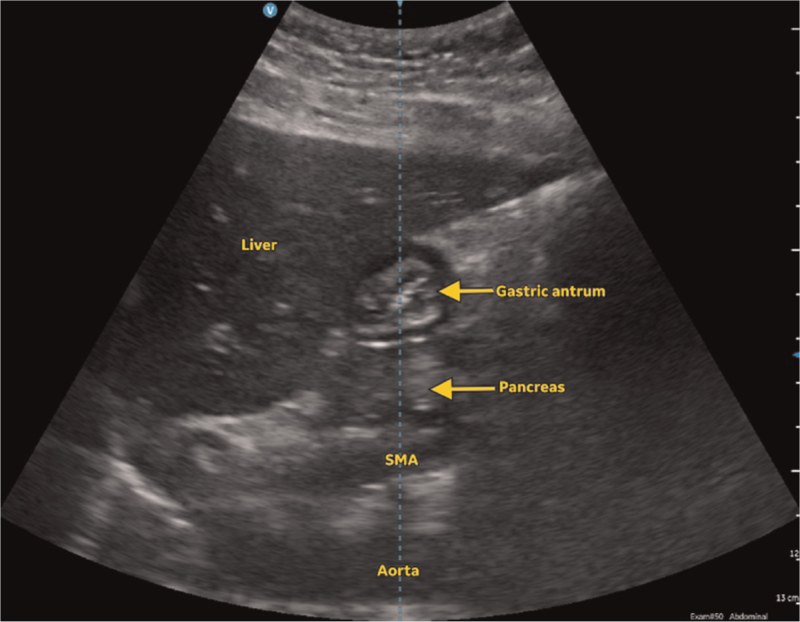
Sagittal epigastric, cranial on the left, anterior at top
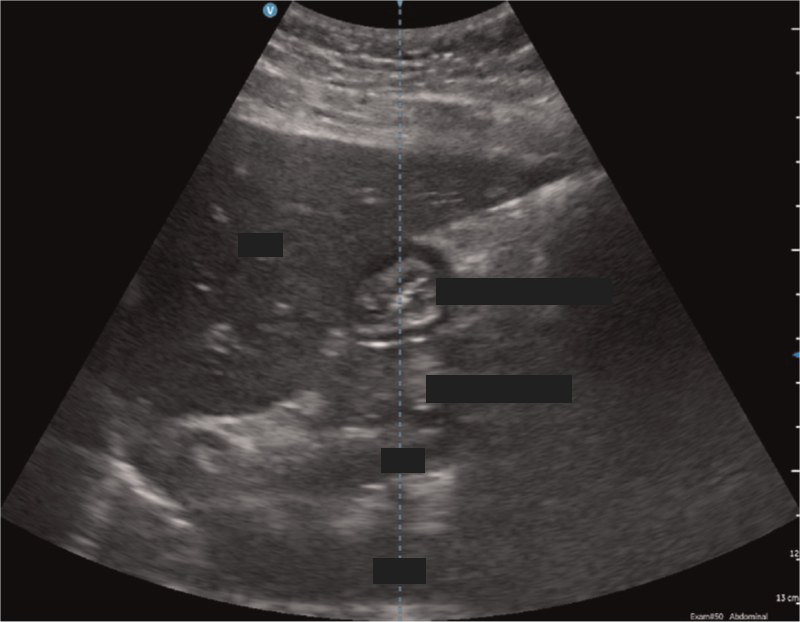 , open the image full size
Show the answerHide the answer
 , open the image full size
Labels Liver · gastric antrum · pancreas · SMA superior mesenteric artery · aorta
- Under the left liver lobe, this round target is the gastric antrum.
- Deep to it runs the aorta, so I am in the right plane.
- Empty, the antrum is small and flat; here it is distended.
- Dark contents mean clear fluid; a hazy, frosted look means solid food.
- I measure its area on the right side to estimate volume.
- Left lobe of liver Acoustic window lying above the antrum
- Gastric antrum Round target shape that swells as content increases
- Aorta Deep landmark confirming the right plane
- Antral contents Clear fluid dark; thick fluid bright; solids ground-glass
- Antral area in right lateral position Gives volume; solids or above 1.5 mL/kg means full
Checked against: Barash 9e · Miller 10e
Image: Desai N et al., The pregnant and postpartum stomach (Eur J Anaesthesiol 2026; doi:10.1097/eja.0000000000002320), Fig. 2, CC BY 4.0. Changes: Whole image kept, no crop. Question image: yellow Liver, Gastric antrum (with arrow), Pancreas (with arrow), SMA and Aorta labels covered with boxes; the machine centre line is kept
Fatal mistakes
- Proceeding against safety.
- Arguing back.
- Blaming the patient.
Checked against: Miller 10e · Practice Guidelines for Preoperative Fasting and the Use of Pharmacologic Agents to Reduce the Risk of Pulmonary Aspiration: Application to Healthy Patients Undergoing Elective Procedures (An Updated Report) (2017) · Multi-society guidance on GLP-1 receptor agonists before procedures (2024)
Report a problem with this case
Mark Got it only if you said every point. Again brings the case back tomorrow; Got it brings it back in 3, then 7, 14 and 30 days.