DOPS: labour epidural, dural puncture and local anaesthetic toxicityDOPS: a 30-year-old woman, G2P1, 75 kg, in established labour at 6 cm
From memory: the diagnosis and the notes are hidden. Answer each question aloud, then press Show.
Know this first
- Lateral position, fluid before threading and under 6 cm of catheter reduce vein cannulation.
- Adrenaline 15 mcg IV raises HR by at least 10; labour pain can mimic a positive test.
- Labour mix: bupivacaine 0.0625–0.1% with fentanyl 1–3 mcg/mL.
- Dural puncture: intrathecal catheter or re-site at another level; headache in 30–60%.
- LAST: lipid 20% early; over 70 kg, 100 mL over 2–3 min then 250 mL over 15–20 min.
The patient
The examiner asks
Answer aloud, then press Show.
Prepare
How do you prepare?
Show the answerHide the answer
- Check consent, platelets, no anticoagulants, and that the midwife is with us. (Procedure step)
- IV cannula running, blood pressure cycling, saturation probe, fetal heart monitoring.
- Resuscitation drugs and lipid emulsion in the room.
- Full asepsis: hat, mask, sterile gown and gloves, skin prep, wide drapes.
- She lies on her side, which lowers the chance of entering a vein.
Perform
Talk me through insertion and loading.
Show the answerHide the answer
- Local to the skin, Tuohy needle with saline, loss of resistance at a noted depth. (Procedure step)
- Saline down the needle, then thread the catheter, leaving under 6 cm in the space.
- Aspirate the catheter: aspiration picks up almost every catheter sitting in a vessel.
- Test dose with adrenaline 15 mcg; heart rate up 10 or more suggests a vessel.
- Load with bupivacaine 0.0625–0.1% plus fentanyl 1–3 mcg/mL, in divided doses.
- Check the block with cold, label the catheter, and hand over to the midwife.
Crisis
As you advance the Tuohy needle, clear fluid flows freely from the hub. What do you do?
Show the answerHide the answer
- Accidental dural puncture: I stop and leave the needle where it is. (Crisis)
- Either thread an intrathecal catheter, or withdraw and re-site at another space.
- An intrathecal catheter is labelled clearly; no epidural doses are ever given through it.
- I tell her: 30–60% get a headache after this, and we can treat it.
- Document it and arrange daily review for headache.
Crisis
Five minutes after a top-up she reports ringing in her ears and tingling lips. BP 138/88, HR 118, fetal heart 150.
Show the answerHide the answer
- Local anaesthetic toxicity: ASRA checklist. Stop injecting and call for help. (Crisis)
- Airway and 100% oxygen; left uterine displacement against aortocaval compression; fetal monitoring stays on.
- Give lipid early. She's over 70 kg: 100 mL of 20% over 2–3 minutes.
- Then 250 mL over 15–20 minutes as an infusion; still unstable: give the bolus again, double the rate.
- If she fits: midazolam 1–5 mg IV.
- If she arrests: CPR, with adrenaline kept under 1 mcg/kg per dose, and vasopressin avoided.
- Deliver the baby within minutes, and alert the bypass team.
Scan · Lumbar spine for neuraxial block
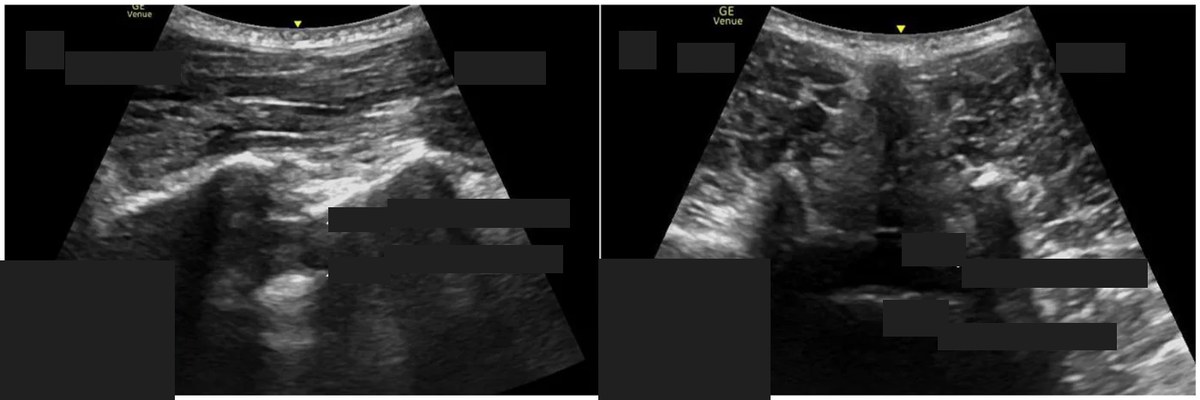
Here is your image. Point to and name each structure, then say why it matters.
Low-frequency curvilinear probe longitudinal, 2–3 cm off midline tilted toward the canal, then turned transverse over the chosen interspace.
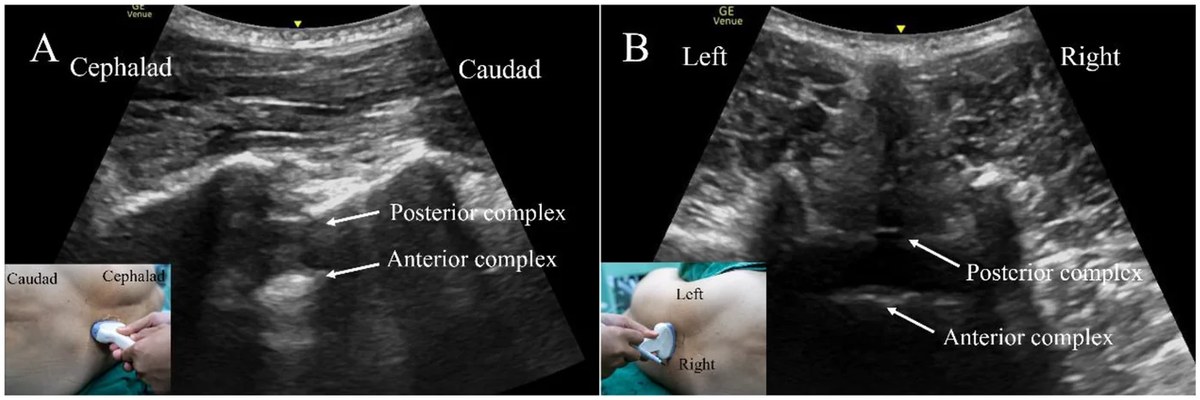
Left panel paramedian sagittal oblique, cephalad on the left; right panel transverse interlaminar, patient's left on the left
 , open the image full size
Show the answerHide the answer
 , open the image full size
Labels Posterior complex · anterior complex (arrows)
- Paramedian, this flat bright band is sacrum, so I count up from here.
- These teeth are laminae; the gaps between them are my windows.
- In the window, this upper bright line is ligamentum flavum with dura.
- The deeper line is the front of the canal and vertebral body.
- Turned across, these paired shadows are articular and transverse processes; I mark midline and interspace.
- Sacrum Flat bright band: count levels upward from here
- Laminae Saw-tooth pattern in the paramedian view
- Ligamentum flavum–dorsal dura Posterior complex; measure depth to it
- Anterior complex Deeper bright line: ventral dura and vertebral body
- Articular and transverse processes Paired lateral shadows in the transverse view
- Bone shadow Dark band under bone; windows let the beam through
Checked against: Barash 9e · Miller 10e
Image: Zhuang W et al., Ultrasound-assisted modified paramedian approach vs. traditional paramedian approach for spinal anesthesia in lower limb surgery: a single-center randomized controlled trial (Front Med (Lausanne) 2026; doi:10.3389/fmed.2026.1903864), Figure 1, CC BY 4.0. Changes: Both panels kept, resized to 1200 px wide. Question image: panel letters, the Cephalad/Caudad/Left/Right words, the posterior and anterior complex labels and arrows, and both probe-position inset photos (which carry orientation words) covered with boxes
Fatal mistakes
- Loading without aspiration or a test dose.
- An unlabelled intrathecal catheter.
Checked against: Miller 10e · Barash 9e · ASRA Pain Medicine Local Anesthetic Systemic Toxicity checklist: 2020 version
Report a problem with this case
Mark Got it only if you said every point. Again brings the case back tomorrow; Got it brings it back in 3, then 7, 14 and 30 days.