Numb, weak hand the day after a supraclavicular blockActor: a 38-year-old carpenter, day 1 after plate fixation of a wrist fracture under supraclavicular block
From memory: the diagnosis and the notes are hidden. Answer each question aloud, then press Show.
Know this first
- Nerve injury after peripheral nerve block: up to 4.2 per 10,000.
- Ultrasound-guided blocks: symptoms 18/10,000 lasting under 5 days, 9/10,000 beyond 6 months.
- Causes: needle or catheter trauma, ischaemia, infection; most injuries have several causes.
- Most settle within days or weeks; significant deficits need specialist review.
- Nerve conduction studies and EMG help diagnosis and prognosis.
The patient
The examiner asks
Answer aloud, then press Show.
Open
How do you start?
Show the answerHide the answer
- I'm seeing a carpenter whose hand is still numb and weak the day after a nerve block. Patient
- Show me exactly where it's numb, and tell me what you can't do. Communication
- First I loosen any tight dressing or cast, and check for swelling or compartment syndrome.
- I'd like to examine both hands and arms now, side by side.
- I'll test feeling, finger and thumb movements and grip, nerve by nerve.
Explain
Explain your findings and the possible causes.
Show the answerHide the answer
- The pattern shows which nerves are affected; I'm writing it down precisely. (Communication)
- Several things can cause this: the block needle, the surgery, the tourniquet, swelling or positioning.
- Most problems like this settle within days or weeks.
- Symptoms lasting beyond six months happen in about 1 in 1,000 such blocks.
Respond
He says: 'I was told this was safe.'
Show the answerHide the answer
- You were told the risk was small, and it is. But it has happened to you, and I'm sorry. (Communication)
- I won't brush this aside. We'll take it seriously and see it through.
- What worries you most about it right now?
Respond
He asks: 'Will it recover? I need my hand for work.'
Show the answerHide the answer
- Most people recover fully, but I can't promise until we know more. (Communication)
- I'm asking a neurologist to see you; nerve tests will show the extent and outlook.
- Meanwhile, protect the numb hand from heat and knocks, and keep the joints moving.
Close
How do you close?
Show the answerHide the answer
- I'll report this as an incident so it is reviewed. Communication
- Today's examination is recorded, so we can measure any change.
- I'll see you before discharge and book you into clinic with the neurologist.
- He has my number and knows to return early if the weakness spreads or worsens. After surgery
Scan · Supraclavicular brachial plexus
Here is your image. Point to and name each structure, then say why it matters.
Linear probe just above and parallel to the clavicle, coronal oblique, slid medially until the subclavian artery is centred.
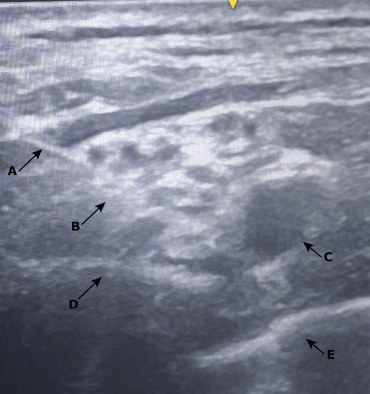
Transverse (coronal oblique) right supraclavicular fossa; lateral on the left, medial on the right
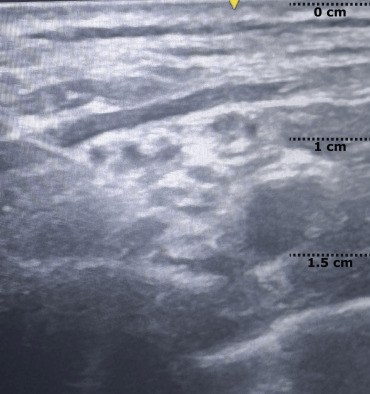 , open the image full size
Show the answerHide the answer
 , open the image full size
Labels A needle · B brachial plexus · C subclavian artery · D first rib · E pleura
- This round pulsing circle is the subclavian artery; Doppler confirms it.
- Up and lateral to it is the plexus, a bunch of dark grapes.
- This bright line with a shadow under it is the first rib.
- Next to the rib is pleura; I keep the rib between my needle and lung.
- I aim for the corner beside the artery, sitting on the rib.
- Half or more of these patients get a phrenic block.
- Subclavian artery Round, pulsatile, Doppler-confirmed: the central landmark
- Plexus trunks/divisions Grape cluster superolateral to the artery, above the rib
- First rib Bright line with shadow: the backstop shielding the pleura
- Pleura Pneumothorax is the main risk; rib must cover it
- Subclavian vein Lies inferomedial to the artery; a vessel to avoid
Checked against: Barash 9e · Miller 10e · Faust
Image: Falchetti RG et al., The Anesthetic Management of a Patient With Advanced Heart Failure Undergoing Non-cardiac Surgery (Cureus 2026; doi:10.7759/cureus.103869), Figure 1, CC BY 4.0. Changes: Question = left half (unlabelled twin, depth marks only); answer = right half with arrows A-E. No covering needed.
Fatal mistakes
- Dismissing it without examining.
- Nothing documented.
- No neurology referral.
Checked against: Barash 9e · Miller 10e
Report a problem with this case
Mark Got it only if you said every point. Again brings the case back tomorrow; Got it brings it back in 3, then 7, 14 and 30 days.