DOPS: fibreoptic intubation through a supraglottic airway, and laryngospasmDOPS: a 50-year-old man, 85 kg, for emergency evacuation of an extradural haematoma
DOPS: fibreoptic intubation through a working supraglottic airway, and laryngospasm
From memory: the diagnosis and the notes are hidden. Answer each question aloud, then press Show.
Know this first
- Oxygenating via the SAD: stop, think, communicate; wake him if proceeding isn't essential.
- Tube essential: one fibreoptic attempt through the SAD, or a front-of-neck airway.
- An Aintree catheter over the scope converts the SAD to a tracheal tube.
- Laryngospasm: remove the irritant, deepen, give a rapid-onset relaxant such as suxamethonium; CPAP may worsen it.
The patient
The examiner asks
Answer aloud, then press Show.
Prepare
How do you prepare?
Show the answerHide the answer
- He's oxygenating on the supraglottic airway, so I stop, think and talk to the team. (Procedure step)
- Waking him isn't an option: the haematoma must come out now, so a tube is essential.
- One attempt only, through the device with a fibreoptic scope; front-of-neck kit open.
- Paralyse him first with rocuronium 1.2 mg/kg; sugammadex drawn up beside me.
- Aintree catheter loaded on the scope; swivel connector so ventilation continues.
- Deep anaesthesia on 100% oxygen throughout.
Perform
Talk me through the intubation.
Show the answerHide the answer
- Scope through the device until I see the cords. (Procedure step)
- Through the cords to tracheal rings and carina.
- Slide the Aintree off the scope into the trachea, then remove the scope.
- Remove the supraglottic airway, keeping the Aintree still.
- Railroad the tube over the Aintree, then remove it.
Perform
How do you confirm the tube, and what follows?
Show the answerHide the answer
- Waveform capnography first: a sustained trace confirms the trachea. (Procedure step)
- Scope through the tube to see rings and carina, and set the depth.
- I record the grade 4 view, the attempts and the technique that worked.
- Before discharge he gets a difficult airway letter, and his record is flagged.
Crisis
The rocuronium syringe is found still full: it was never given. As the scope touches the cords, he makes a high-pitched noise and the bag stops moving. SpO2 85%, HR 112.
Show the answerHide the answer
- Laryngospasm: take the scope off the cords and give 100% oxygen. (Crisis)
- Deepen anaesthesia with a propofol bolus.
- Rapid-onset relaxant now: suxamethonium 1.5 mg/kg IV.
- I don't rely on CPAP here; the pressure can push the folds together and worsen spasm.
- Firm pressure behind the jaw, at the laryngospasm notch, can also break it.
- Once saturation recovers I complete this one attempt; if it fails, front-of-neck airway, not a retry.
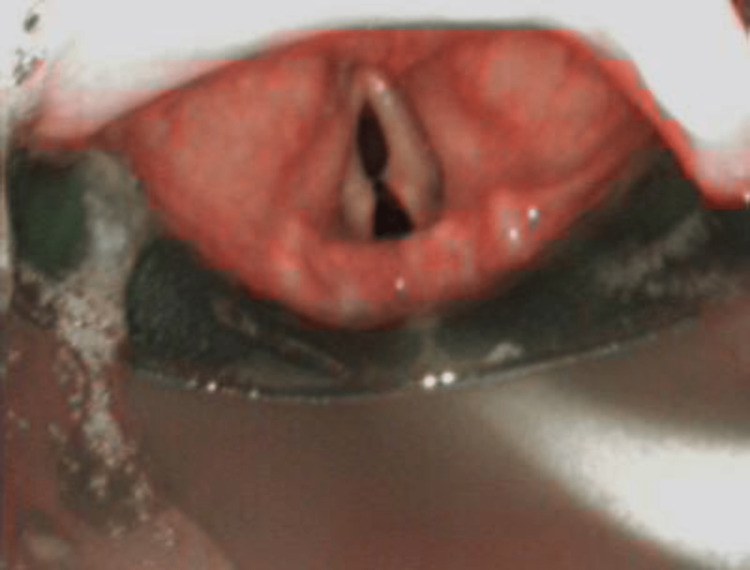
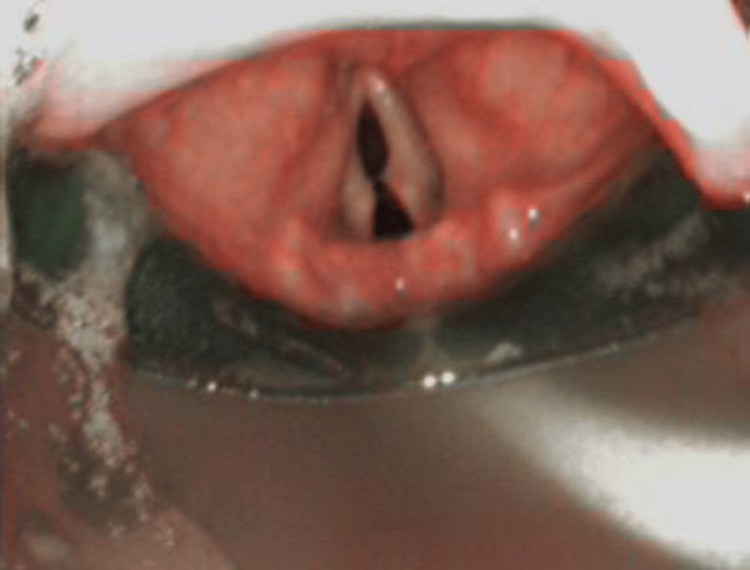
Scan · Fibreoptic view through a supraglottic airway
Here is your image. Point to and name each structure, then say why it matters.
Flexible bronchoscope down the SAD's airway tube, with or without an Aintree catheter.
Looking down through the i-gel bowl onto the glottis; device bowl at the bottom
 , open the image full size
Show the answerHide the answer
 , open the image full size
This image carries no labels of its own; the structures are named below.
- One attempt through the SAD, only if the patient is stable and oxygenating.
- Through the scope, this flap is the epiglottis; folded down, I reseat the device.
- On a Fastrach, the bar lifts the epiglottis as the tube leaves the bowl.
- These are the vocal cords; with full relaxation they stay open.
- I watch the tube pass between the cords into the trachea, never going blind.
- Then I confirm with sustained end-tidal carbon dioxide too.
- Bowl aperture and elevating bar (Fastrach) Bar lifts the epiglottis as the tube leaves the bowl
- Epiglottis Folded down it obstructs; up–down manoeuvre can clear it
- Vocal cords Tube must be watched passing between them; relaxant holds them open
- Trachea beyond the cords Tube seen here plus capnography; CO2 alone misses bronchial or pharyngeal tubes
Checked against: DAS 2025 · Barash 9e · Miller 10e
Image: Stagg PL., Bronchoscope-Guided Airway Rescue via an I-gel™ for Haematoma-Induced Airway Obstruction Following Anterior Cervical Spine Surgery (Cureus 2023; doi:10.7759/cureus.34990), Figure 1, CC BY (version as stated at the source). Changes: No labels, so the question and answer images are the same uncropped frame
Fatal mistakes
- Persisting with attempts while oxygenation fails.
- No capnography.
- Repeated scoped attempts instead of a front-of-neck airway when the tube is essential.
Checked against: DAS 2025 · Miller 10e · Barash 9e
Report a problem with this case
Mark Got it only if you said every point. Again brings the case back tomorrow; Got it brings it back in 3, then 7, 14 and 30 days.