Chronic pain after mastectomy: serratus block and LAST52-year-old woman, 64 kg, seen in pain clinic 8 months after left mastectomy with axillary clearance
From memory: the diagnosis and the notes are hidden. Answer each question aloud, then press Show.
Know this first
- Chronic post-surgical pain: present beyond 2 months after surgery, with no other explanation.
- First-line neuropathic drugs: gabapentinoids, SNRIs, tricyclics. Second-line: capsaicin 8% patch, topical lidocaine, tramadol.
- Block ceilings: ropivacaine 3 mg/kg, bupivacaine 2 mg/kg.
- Lipid 20% at 70 kg or less: 1.5 mL/kg over 2–3 min, then 0.25 mL/kg/min. Ceiling 12 mL/kg.
The patient
The examiner asks
Answer aloud, then press Show.
Consider
What are your considerations?
Show the answerHide the answer
- A 52-year-old with burning chest-wall and arm pain 8 months after mastectomy with axillary clearance. Patient
- Pain past 2 months that nothing else explains is chronic post-surgical pain. Disease
- In a cancer patient new pain can mean progression, so oncology must exclude recurrence first.
- Her inner-arm burning lies in the intercostobrachial, T2, territory, which points to nerve injury. Surgery
Prepare
How do you assess her?
Show the answerHide the answer
- Burning, numbness and allodynia make her pain neuropathic; I map the sensory change over the arm. Disease
- I score her pain, sleep, mood and function, because anxiety and poor sleep feed her pain. Patient
- A psychologist assesses how the pain affects her feelings, thinking, behaviour and work.
- I ask how much tramadol she really takes and what she hopes treatment will change.
Plan
What is your treatment plan?
Show the answerHide the answer
- First line for her: one of a gabapentinoid, SNRI or tricyclic, started low and titrated. Disease
- Second line: a lidocaine plaster or capsaicin 8% patch over the painful chest wall.
- Tramadol is already second line; I won't escalate to strong opioids for nerve pain.
- Psychology input with CBT and relaxation for her anxiety and sleep. Patient
Plan
She opts for an ultrasound-guided serratus anterior plane block. How do you do it safely?
Show the answerHide the answer
- The serratus plane holds her intercostobrachial nerve and the lateral cutaneous intercostal branches. Surgery
- Monitoring, IV access, the LAST kit with lipid and an airway trolley ready before I start. Crisis
- Ropivacaine stays under its 3 mg/kg ceiling; I use the smallest volume that covers the plane. Disease
- Ultrasound to watch the spread, aspiration before each injection, 3–5 mL at a time. Surgery
- I keep talking to her throughout, so early symptoms of toxicity are caught. Patient
Crisis
Midway through injection she reports a metallic taste and numb lips, then has a tonic-clonic seizure. BP 150/90, HR 118, SpO2 93%. What do you do?
Show the answerHide the answer
- LAST algorithm: metallic taste and perioral numbness, then a seizure, during her ropivacaine injection. Crisis
- I stop the injection and call for help; someone fetches the LAST kit; bypass team warned.
- Airway first: 100% oxygen and support her breathing; hypoxia and acidosis worsen toxicity.
- Seizure: midazolam 1–5 mg IV; propofol only in 20 mg steps if no benzodiazepine.
- Lipid 20% early: she's under 70 kg, so 1.5 mL/kg over 2–3 minutes, then 0.25 mL/kg/min.
- Should she become unstable: small adrenaline, below 1 mcg/kg, and avoid vasopressin, beta-blockers, calcium blockers, lidocaine.
- Once stable, lipid runs at least 15 more minutes; I observe her for at least 2 hours. After surgery
Scan · Serratus anterior plane
Here is your image. Point to and name each structure, then say why it matters.
Linear 13–6 MHz probe from the midclavicular line slid down and out to ribs 4–5 at the mid-axillary line.
Orientation not marked; rib and its acoustic shadow on the left, latissimus superficial and pleura deep on the right
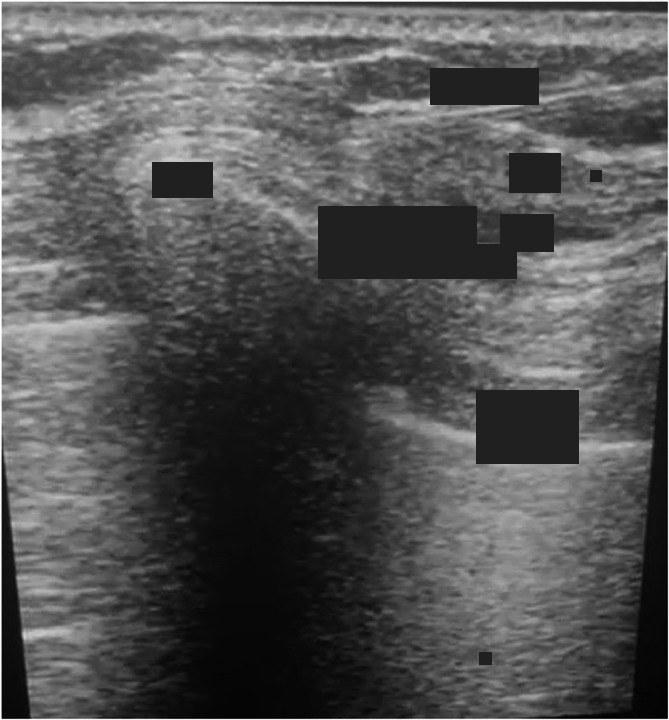 , open the image full size
Show the answerHide the answer
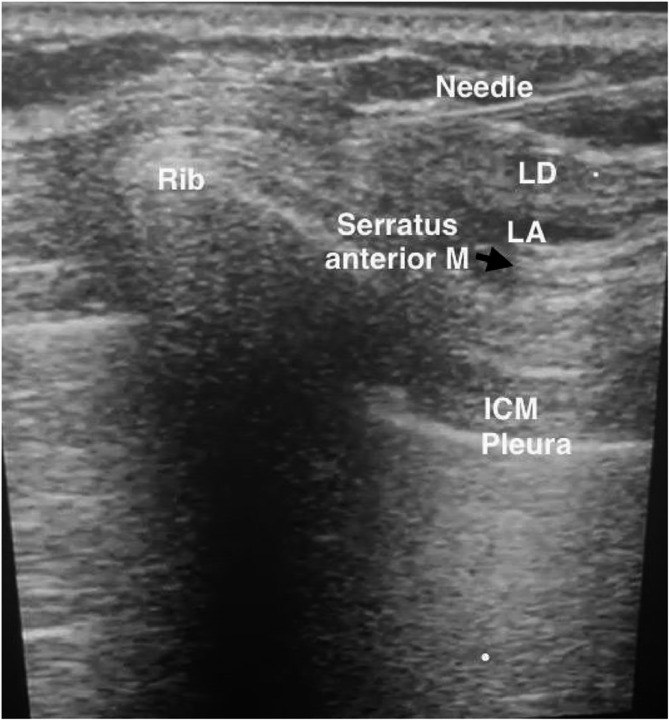 , open the image full size
Labels LD latissimus dorsi · Serratus anterior M · Rib · LA local anaesthetic · ICM intercostal muscle · Pleura
- At the mid-axillary line, this top muscle is latissimus dorsi.
- Under it, the thin muscle on the ribs is serratus anterior.
- This small vessel between them is the thoracodorsal artery.
- These rib shadows are my backstop, with pleura between them.
- I can inject over or under serratus; spread is similar.
- Latissimus dorsi Top muscle; superficial plane lies beneath it
- Serratus anterior Thin muscle on the ribs; inject above or below
- Thoracodorsal artery Lies between the two muscles; avoid it
- Fourth/fifth rib Bony backstop under the needle
- Pleura Bright line between rib shadows; stay off it
Checked against: Barash 9e · Miller 10e
Image: Abd Ellatif SE et al., Ultrasound-guided modified versus conventional serratus anterior plane block as a preemptive analgesic for unilateral video-assisted thoracoscopic surgery (BMC Anesthesiol 2025; doi:10.1186/s12871-025-03314-5), Fig. 1, CC BY 4.0. Changes: Kept the full sonogram; in the question image the Needle, Rib, LD, LA, 'Serratus anterior M', 'ICM Pleura' labels, the black arrow and two small marker dots are covered with dark grey.
Fatal mistakes
- Labelling her pain neuropathic without asking whether the cancer has come back.
- Arrest-dose adrenaline, 1 mg, for local anaesthetic toxicity.
- Large propofol doses in place of lipid when she is unstable.
- Injecting the full volume at once, without aspiration or increments.
Checked against: Miller 10e · Barash 9e · ASRA Pain Medicine Local Anesthetic Systemic Toxicity checklist: 2020 version
Report a problem with this case
Mark Got it only if you said every point. Again brings the case back tomorrow; Got it brings it back in 3, then 7, 14 and 30 days.