Hip fracture on apixaban: block choice and LAST76-year-old woman, 64 kg, with a displaced right hip fracture after a fall; theatre is booked for tomorrow morning
From memory: the diagnosis and the notes are hidden. Answer each question aloud, then press Show.
Know this first
- Full-dose apixaban needs 72 h off before neuraxial or deep blocks, unless the measured level is below 30 ng/mL.
- Superficial blocks need no drug-free interval; deep blocks follow neuraxial rules.
- Hip fracture surgery within 48 h lowers inpatient mortality and pressure sores.
- LAST: lipid early, adrenaline under 1 mcg/kg, amiodarone for ventricular arrhythmia, no lidocaine.
The patient
The examiner asks
Answer aloud, then press Show.
Consider
What are your considerations?
Show the answerHide the answer
- A 76-year-old, 64 kg, with a hip fracture, on full-dose apixaban for AF, needing early fixation. Patient
- Already forgetful at 76: I record her baseline cognition now, as delirium risk climbs after 60.
- Fixing her hip within 48 hours lowers her inpatient mortality and pressure sores. Surgery
- Her age puts her among those at higher risk of local anaesthetic toxicity. Patient
Prepare
Is her heart a reason to delay surgery?
Show the answerHide the answer
- Urgency: her fixation should happen within 48 hours, so assessment mustn't delay it. Stem trigger
- Active cardiac conditions? None: her AF is rate-controlled at 88, with no failure, ischaemia or severe valve disease. Disease
- RCRI 0: hip surgery isn't high-risk, and she has no coronary disease, failure, stroke, insulin or creatinine over 2.
- Functional capacity: a broken hip stops her walking; any disability counts as under 4 METs.
- Decision: RCRI 0 is low risk, so no stress testing; I proceed.
Prepare
Can she have a spinal tomorrow morning?
Show the answerHide the answer
- Full-dose apixaban needs at least 72 hours off before a spinal or a deep block. Disease
- Her last dose was this morning, so tomorrow is only about 24 hours: too soon.
- Her clearance of 38 mL/min makes timing alone less reliable, so I'd rather measure a level.
- Earlier only if a drug level shows apixaban below 30 ng/mL; an anti-Xa no higher than 0.1 IU/mL also works.
- Without that level, no spinal: she has general anaesthesia rather than a delayed operation. Surgery
Plan
How do you manage her pain and her anaesthetic?
Show the answerHide the answer
- Fascia iliaca block in the emergency department now, for her pain before surgery. Surgery
- It's a superficial block, so apixaban doesn't delay it; deep blocks follow spinal timing. Disease
- Ropivacaine well under 3 mg/kg; her age justifies a cautious dose. Patient
- Nerve blocks may also reduce her delirium, so it helps twice.
- GA with less propofol: in older adults, more than 1.5 mg/kg causes severe hypotension.
Crisis
Fifteen minutes after the fascia iliaca block she becomes confused, then has a broad-complex tachycardia at 150 with BP 70/35. What do you do?
Show the answerHide the answer
- LAST algorithm: confusion then a broad-complex arrhythmia after her large-volume block. (Crisis)
- Help called, LAST kit fetched, and the bypass team warned early.
- 100% oxygen and airway support; hypoxia and acidosis make the toxicity worse.
- Lipid 20% now: under 70 kg, 1.5 mL/kg over 2–3 minutes, then 0.25 mL/kg/min.
- Arrhythmia: amiodarone if needed; never lidocaine, beta-blockers, calcium blockers or vasopressin.
- If pulseless, CPR with adrenaline under 1 mcg/kg; still unstable, repeat the bolus, double the infusion.
- Resuscitation may be long; cardiopulmonary bypass if lipid and CPR fail.
Scan · PENG block
Here is your image. Point to and name each structure, then say why it matters.
Linear probe lying in line with the groin crease and inguinal ligament, spanning ASIS to pubic ramus (corpus says linear, not curvilinear).
PENG view, curvilinear probe transverse-oblique over the iliopubic eminence; medial on the left
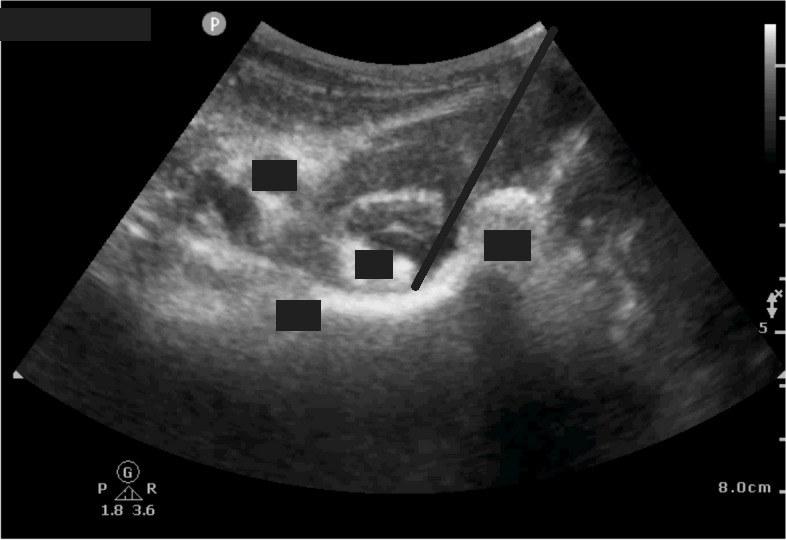 , open the image full size
Show the answerHide the answer
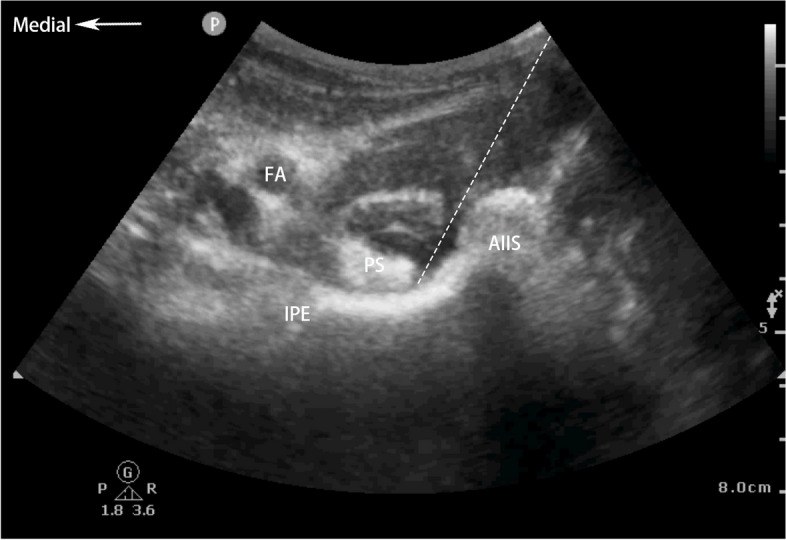 , open the image full size
Labels FA femoral artery · PS psoas tendon · IPE iliopubic eminence · AIIS anterior inferior iliac spine
- Laterally, this bony bump is the anterior inferior iliac spine.
- Medially, this rise of bone is the iliopubic eminence on the pubic ramus.
- This bright band over the bone is the psoas tendon; my tip lands lateral to it.
- This pulsing circle is the femoral artery, so I aspirate first.
- The drug bathes the hip's sensory twigs, while leaving most leg strength intact.
- Anterior inferior iliac spine Lateral bony landmark of the view
- Iliopubic eminence / superior pubic ramus Bone the needle tip contacts, beside the psoas tendon
- Psoas tendon Deposit lateral to it, never inside muscle
- Femoral artery Nearby vessel: aspirate before injecting
- Articular branches (not seen) Femoral, accessory obturator, obturator twigs to the hip: motor-sparing target
Checked against: Miller 10e · Barash 9e
Image: Cui X et al., Effect of pericapsular nerve group block and suprainguinal fascia iliaca block on postoperative analgesia and stress response in elderly patients undergoing hip arthroplasty: a prospective randomized controlled double-blind trial (BMC Anesthesiol 2024; doi:10.1186/s12871-024-02604-8), Fig. 1, CC BY 4.0. Changes: Kept the whole curvilinear sector; in the question image the FA, PS, IPE and AIIS labels, the dashed needle path and the 'Medial' arrow are covered with dark grey.
Fatal mistakes
- A spinal about 24 hours after full-dose apixaban without a level.
- No dose reduction for her age.
- Lidocaine for the broad-complex arrhythmia.
- Delaying her fracture surgery for days to clear the apixaban.
Checked against: Regional anesthesia in the patient receiving antithrombotic or thrombolytic therapy: ASRA Pain Medicine evidence-based guidelines (fifth edition) (2025) · Barash 9e · Miller 10e · AHA/ACC 2024
Report a problem with this case
Mark Got it only if you said every point. Again brings the case back tomorrow; Got it brings it back in 3, then 7, 14 and 30 days.