Multiple rib fractures in an older man with COPD78-year-old man, 74 kg, fell at home: right ribs 4–8 fractured, no pneumothorax on CT
Rib fractures: analgesia choice to prevent respiratory failure in the elderly
From memory: the diagnosis and the notes are hidden. Answer each question aloud, then press Show.
Know this first
- Rib fractures over 55: twice the mortality and chest complications of younger patients.
- Each extra rib fracture raises mortality and pneumonia risk by more than 20% in older adults.
- Epidural gives the best pain relief; serratus, paravertebral and erector spinae blocks are alternatives.
- Aspirin and NSAIDs alone do not change neuraxial timing.
The patient
The examiner asks
Answer aloud, then press Show.
Consider
What are your considerations?
Show the answerHide the answer
- A 78-year-old with five right rib fractures, COPD and a weak cough, on aspirin. Patient
- Past 55, rib fractures double his mortality and chest complications.
- Each extra broken rib raises his death and pneumonia risk by over 20%. Disease
- My goal: analgesia good enough for deep breaths and a strong cough.
Plan
What analgesia do you offer him?
Show the answerHide the answer
- Thoracic epidural gives the best relief, and chest trauma guidelines prefer it. Disease
- Aspirin alone doesn't affect epidural timing, so he can have it now.
- If the epidural fails or isn't possible: a paravertebral, serratus or erector spinae catheter.
- Paracetamol 1 g 6-hourly; systemic opioid kept to a minimum.
- Chest physiotherapy and incentive spirometry from day one, in HDU. After surgery
Crisis
Ten minutes after a 6 mL bolus of 0.25% bupivacaine down the epidural, BP is 76/40 and HR 44. He is drowsy. What do you do?
Show the answerHide the answer
- Bradycardia algorithm: HR 44 with hypotension after his thoracic epidural bolus; I call for help. Crisis
- Oxygen, check his breathing and the block height; stop the epidural infusion.
- Atropine 1 mg IV, again every 3–5 minutes if needed, to 3 mg.
- Ephedrine boluses and fluid; I avoid phenylephrine while his heart rate is 44.
- Severe and not responding: adrenaline early, 0.1–1 mcg/kg.
- Restart at a lower rate once stable, with closer checks. After surgery
Crisis
On day two he is confused, SpO2 86% on 4 L, RR 32, with a wet, weak cough. PaCO2 52 mmHg. What do you do?
Show the answerHide the answer
- Sputum retention with hypoxaemia; I escalate him to HDU or ICU now. (Crisis)
- Controlled oxygen for his COPD, aiming for 88–92%, with repeat blood gases.
- NIV can help and may cut pneumonia; intubate if he can't oxygenate or protect his airway.
- I check his epidural is working, because pain stops him coughing.
- Chest physiotherapy and suction; no sedatives for his confusion while he's hypoxic.
Scan · Thoracic paravertebral and erector spinae
Here is your image. Point to and name each structure, then say why it matters.
Parasagittal along the spine, slid laterally onto the transverse processes; linear 13–6 MHz for ESP, curvilinear for PVB or larger patients.
Transverse-oblique thoracic paravertebral, in-plane; medial on the left, anterior deep
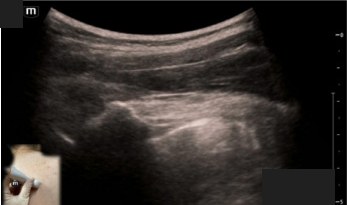 , open the image full size
Show the answerHide the answer
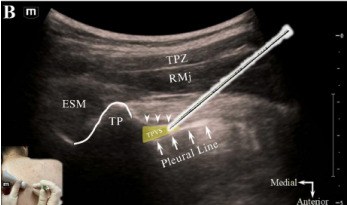 , open the image full size
Labels ESM erector spinae muscle · TP transverse process · TPVS thoracic paravertebral space · RMj rib and ligament junction · pleural line
- With the probe along the spine, these flat square shadows are transverse processes.
- Over them lies erector spinae; for ESP I lift this muscle off the bone.
- Medially the lines overlap as lamina; laterally the round arcs are ribs.
- For paravertebral I pass the costotransverse ligament between two processes.
- This bright line is pleura; a good paravertebral injection pushes it down.
- Erector spinae muscle ESP: drug goes deep to it, lifting it off bone
- Transverse process Flat square shadow; bony backstop for ESP
- Lamina Overlapping lines medially; scan lateral off it
- Rib Deeper rounded arc lateral to the transverse process
- Superior costotransverse ligament PVB needle tip passes just through it
- Parietal pleura PVB injection pushes it down; pneumothorax is the feared harm
- Paravertebral space Deep to the transverse processes, above pleura
Checked against: Barash 9e · Miller 10e
Image: Reeves MT., Thoracic Paravertebral Block for Tube Thoracostomy Analgesia in the Emergency Department: A Case Report (Clin Pract Cases Emerg Med 2025; doi:10.5811/cpcem.47070), Image, CC BY 4.0. Changes: Question = panel A (unlabelled twin), with its figure letter and the Medial/Anterior compass covered; answer = panel B with labels, TP outline, shaded TPVS and drawn needle. Probe-position photo insets kept in both.
Fatal mistakes
- Opioid-only analgesia in a man who cannot cough.
- Placing an epidural without checking his antithrombotic drugs.
- Sedating him while he is hypoxic and confused.
- High-flow oxygen without a target in his COPD.
Checked against: Miller 10e · Regional anesthesia in the patient receiving antithrombotic or thrombolytic therapy: ASRA Pain Medicine evidence-based guidelines (fifth edition) (2025) · Global Strategy for the Diagnosis, Management, and Prevention of Chronic Obstructive Pulmonary Disease, 2025 Report
Report a problem with this case
Mark Got it only if you said every point. Again brings the case back tomorrow; Got it brings it back in 3, then 7, 14 and 30 days.