Flail chest on apixaban for rib fixation78-year-old man, 74 kg, after a fall down stairs
From memory: the diagnosis and the notes are hidden. Answer each question aloud, then press Show.
Know this first
- Over 55, rib fractures carry double the mortality.
- Each extra rib fracture in the elderly adds over 20% to death and pneumonia risk.
- Apixaban: at least 72 h off before neuraxial or deep blocks.
- Contusion can worsen over hours to days; an early clear film doesn't exclude it.
- Drains on suction before positive-pressure ventilation.
The patient
The examiner asks
Answer aloud, then press Show.
Consider
What are your considerations?
Show the answerHide the answer
- A 78-year-old on apixaban with a flail chest and contusion, for surgical rib fixation. Patient
- Elderly trauma: his rib fractures double his mortality, and each extra rib adds over 20%.
- Pain causes splinting, collapse and pneumonia, so analgesia is his main treatment. Disease
- His contusion can worsen over the next hours and days.
- Apixaban 10 hours ago: still active for bleeding and for any block.
Prepare
How do you get him ready for theatre?
Show the answerHide the answer
- Frailty and function recorded: he lives alone and uses a stick. Patient
- Epidural is the guideline choice for chest trauma, but not within 72 hours of apixaban. Disease
- Paravertebral counts as a deep block, so the same 72 hours applies.
- Serratus or erector spinae catheter now; paracetamol 1 g 6-hourly; ketamine 0.05–0.35 mg/kg/h.
- CT head, since he is elderly and anticoagulated; any bleed changes the apixaban plan.
- His pneumothorax is drained before any positive pressure.
- Apixaban stopped; reversal only if he bleeds badly.
Plan
What is your anaesthetic plan for the fixation?
Show the answerHide the answer
- A double-lumen tube so the surgeon can work on a collapsed right lung. Airway
- Reduced propofol for his age; over 1.5 mg/kg causes severe hypotension. Disease
- Protective ventilation for the contused lung: 6 mL/kg, plateau under 30.
- Drain on suction throughout ventilation.
- Extubate in theatre if warm, comfortable and oxygenating, then CPAP or NIV. After surgery
- Paravertebral or epidural catheter once 72 hours from apixaban.
Crisis
After intubation, SpO2 falls to 84%, the drain bubbles continuously and surgical emphysema spreads up his neck. What do you do?
Show the answerHide the answer
- Big air leak with spreading emphysema: I suspect a bronchial tear. Crisis
- Drain checked on suction and not kinked; a second drain if needed.
- Bronchoscopy: blunt tears are mostly found less than 2.5 cm from the carina.
- Isolate the lungs and ventilate the good side.
- Low volumes and pressures to shrink the leak.
- Massive leak or confirmed tear: the surgeon goes to thoracotomy. Surgery
Crisis
Day 2 in ICU after extubation: P/F 120, RR 34, bilateral infiltrates. What do you do?
Show the answerHide the answer
- Contusion progressing to moderate ARDS: P/F 120 is in the 100–200 band. Crisis
- Trial of CPAP or NIV with optimal analgesia.
- Failing: reintubate; 6 mL/kg, plateau under 30, higher PEEP.
- Analgesia reviewed; epidural possible now he's past 72 hours.
- Goals of care discussed with him and his family, given his frailty. After surgery
Scan · Lung sliding and pneumothorax
Here is your image. Point to and name each structure, then say why it matters.
Linear, phased-array or curvilinear probe in a head-to-feet orientation across two ribs; depth 4–6 cm for anterior views.
Top: B-mode across the pleura, skin at top, normal lung left of the M-mode cursor and pneumothorax right of it; bottom: M-mode over time, alternating seashore and barcode
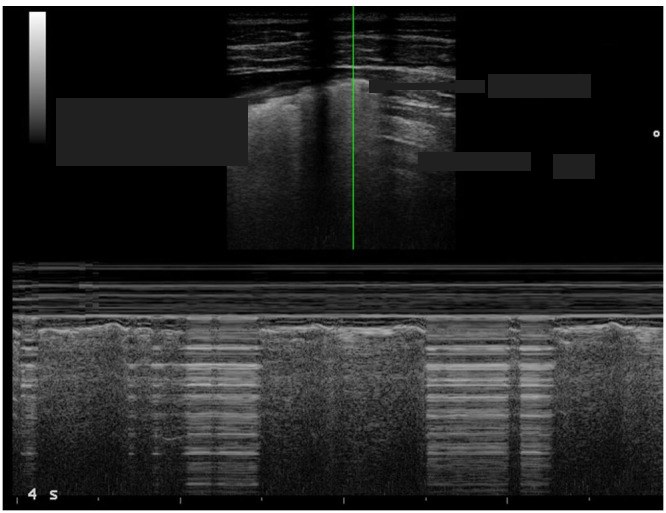 , open the image full size
Show the answerHide the answer
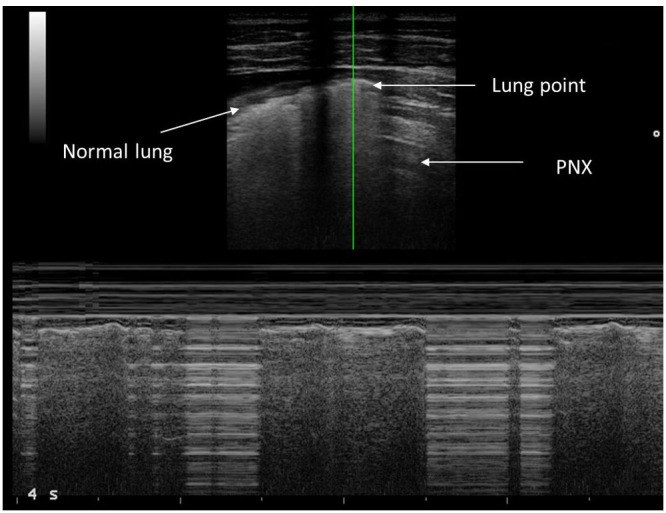 , open the image full size
Labels Normal lung · lung point · PNX pneumothorax
- These two shadows are ribs, and this bright line between them is pleura.
- This shimmer on the pleura is lung sliding, so no pneumothorax here.
- These horizontal copies of the pleural line are A-lines.
- Vertical streaks to the bottom are B-lines; they also exclude pneumothorax.
- On M-mode, sand under the line is normal; stripes all through is barcode.
- Where sliding meets no sliding is the lung point, which confirms pneumothorax.
- Rib shadows Frame the window either side
- Pleural line Bright line just under the ribs; sliding happens here
- Lung sliding (seashore on M-mode) Present means no pneumothorax at that spot
- A-lines Horizontal repeats; dominate when there is a pneumothorax
- B-lines Vertical streaks from pleura; presence rules out pneumothorax there
- Barcode sign No sliding; also seen with one-lung ventilation or adhesions
- Lung point Edge where sliding stops: diagnostic of pneumothorax
Checked against: Barash 9e · Miller 10e
Image: Scialanga B et al., Lung Ultrasound to Detect Pneumothorax in Children Evaluated for Acute Chest Pain in the Emergency Department: An Observational Pilot Study (Front Pediatr 2022; doi:10.3389/fped.2022.812246), Figure 1, CC BY 4.0. Changes: Whole figure kept (B-mode on top, M-mode below). Question image: 'Normal lung', 'Lung point' and 'PNX' labels and their arrows covered with boxes. The lung-point arrow shaft inside the B-mode image is covered with a thin strip
Fatal mistakes
- Positive pressure with an undrained pneumothorax.
- Neuraxial block within 72 hours of apixaban.
- Poor analgesia leading to respiratory failure.
Checked against: Miller 10e · Regional anesthesia in the patient receiving antithrombotic or thrombolytic therapy: ASRA Pain Medicine evidence-based guidelines (fifth edition) (2025)
Report a problem with this case
Mark Got it only if you said every point. Again brings the case back tomorrow; Got it brings it back in 3, then 7, 14 and 30 days.